Welcome!

Welcome to the Sustainable Oban blog where you can post your thoughts and answers to developing and improving the sustainability of Oban and its environs.

Thursday, 20 September 2012

Windfarms could provide windfall for local communities

Hi again

Happy to forward news that the government looks into incentives, such as discounted electricity bills or new playgrounds, for areas that install turbines, just in via the LEG – Lochaber Environmental Group:

Windfarms could provide windfall for local communities

[Press Association/The Guardian, 20 Sept 2012]

Communities that have windfarms in their area could get money off their electricity bills or grants for facilities such as playgrounds, the government has suggested. The Department of Energy and Climate Change has launched a consultation into how communities could benefit from having windfarms sited near them, for example by receiving discounts on other bills or investment in local infrastructure. It will also look at how local businesses could become involved in the supply chain and how developers can best consult local people. Energy secretary Edward Davey said that too often host communities have seen the "windfarm but not the windfall" and he wants to ensure people benefited from them.
Currently the industry pays a minimum of £1,000 per megawatt of turbines installed to local communities, but in some cases companies provide larger benefits packages. The government is also reviewing the cost of onshore wind to ensure subsidies from April 2014 have been set at the right level. Subsidies are due to be cut by 10% from next year, although there were moves by the Treasury to have them reduced by 25%.
Significant opposition to onshore windfarms has been voiced by a number of Tory MPs, who wanted to see subsidies for the technology slashed, but the latest figures show the majority of people are in favour of the turbines. The latest data from Decc's quarterly survey into public attitudes revealed that 66% of people were in favour of onshore wind, although the figure was lower than for other renewable technologies. Onshore wind had the highest level of opposition of the renewable energy sources, although only 12% opposed the technology, with just 4% strongly opposed to it.
Davey said: "Onshore wind has an important role to play in a diverse energy mix that is secure, low carbon and affordable. We know that two-thirds of people support the growth of onshore wind. But far too often, host communities have seen the windfarms but not the windfall. We are sensitive to the controversy around onshore wind and we want to ensure that people benefit from having windfarms sited near to them.
But the Campaign to Protect Rural England (CPRE) warned the government against promoting a system in which communities were "paid off" to secure planning permission for windfarms. Tom Leveridge, senior energy campaigner for CPRE, said: "We must make sure that this does not promote simplistic notions of 'sharing benefits' that amount to little more then paying off communities to secure planning permission. This would fundamentally undermine a core principle of the planning system – that planning permission should not be bought or sold – and put the countryside at greater risk from poorly sited wind developments."

For the original article, see:

Wednesday, 19 September 2012

New Biofuelwatch Report – Sustainable Biomass: A Modern Myth

Hi again
A week ago, Biofuelwatch released a new report, ‘Sustainable Biomass: A Modern Myth’. 

Several years before I arrived in Argyll, I had the opportunity to see the destructive effects of large landowners scrabbling for land to produce the new commodity of "biofuel" in Colombia. It keeps happening, to the great distress of crofters, very small landowners in Las Pavas, Sur de Bolivar.
Here's a video documenting the peaceful resistance of villagers/smallholding farmers against the illegal destruction of their land and of their property by Aportes San Isidro S.A., one of the world's big palm oil producers:
(In Spanish – the farmers' resilience, resistance and faith-based humour is admirable –
they've been fighting this "dirty game" for six years!)

What initially looked like a great idea has contributed to world hunger, mass displacement of people in the third world, and certainly hasn't helped to push us toward reducing our energy consumption, quite the contrary.

The Biofuelwatch report "explores the certification companies certifying biomass as sustainable, the UK government’s proposed sustainability criteria for biomass, and developer’s ‘promises’ to source sustainable biomass."

Download Sustainable biomass: A modern myth –  A review of standards, criteria and schemes certifying industrial biomass as ‘sustainable’, with particular emphasis on UK biomass electricity developments, Biofuelwatch report [Note: File size 4.75 MB]

Download the Report without pictures (831 kb) here.

Download the Executive Summary (4 pages)


And here's a link to a few good, critical articles in The Guardian:
http://www.guardian.co.uk/environment/biofuels

Friday, 10 February 2012

Make "green energy" truly sustainable

UK RENEWABLES POLICY alert (for UK residents only)

Having received an alert from www.biofuelwatch.org.uk earlier today, I have sent the following letter to Alan Reid, MP.

Please feel free to visit the Biofuelwatch Website, where you will find the letter that you can adapt to suit your own situation.


'Green energy' subsidies should not be used to stimulate burning of biofuels and biomass

Dear Sir/Madam,

Re: 'Green energy' subsidies should not be used to stimulate burning biofuels and biomass

This is not the first time that I am writing to you as the Secretary of Sustainable Oban, but today I am writing from a personal angle as well because some of my family live in one of the countries most seriously affected by EU legislation.

Please therefore allow me to express my deep concern that existing UK policy on Renewable Electricity is flawed and that the proposals due to be introduced in 2011 for Renewable Heat are likely to exacerbate the problem. Currently the Renewable Obligation gives high levels of financial support to electricity generators to burn liquid biofuels, including palm oil and soybean oil, and biomass, including imported wood from destructive logging and plantations.

A major increase in renewable energy is essential, but it must be renewable energy which truly mitigates climate change and protects, rather than harms the environment. Burning large volumes of biofuels and industrial biomass will have the opposite effect. It will also lead to more land being used to grow crops and trees for fuel instead of food and will put more pressures on indigenous peoples, small farmers and other communities in other countries who, in Colombia, Indonesia and Malaysia in particular (one of my sources is pbi – Peace Brigades International, a human rights organisation with "unarmed bodyguards" in Colombia and Indonesia), are already losing their lives, land and livelihoods to oil palm and other plantations.

These problems arise because of financial support arrangements implemented by the UK Government. Such arrangements are permitted under EU legislation, but are not required of member states.

Electricity from burning liquid biofuels and solid biomass is now eligible for twice the subsidy (paid as Renewable Obligation Certificates or ROCs) as generating electricity from onshore wind. Biofuel power stations burning 'virgin vegetable oil' are only financially viable because of this subsidy. A series of sizeable biofuel electricity power stations has been proposed as a result of these market subsidies, two of the developers make it clear that they intend to burn palm oil while the others have failed to legally commit themselves to not doing so. Palm oil is the cheapest vegetable oil on the market, and according to UNEP is the main cause of deforestation in Indonesia and Malaysia. Deforestation in both countries is linked to the destruction of peatlands and the emissions of vast quantities of carbon. Carbon emissions from peat fires in Indonesia, linked to plantation expansion, have on several occasions been higher than the UK's entire annual CO2 emissions. Palm oi
l expansion is also linked to the displacement of large numbers of communities, unlawfull killings, land conflicts and the destruction of indigenous peoples' and other communities' livelihoods.

A typical 25 MW biofuel power station would require some 10,000 hectares of oil palm plantations to supply its fuel, adding to pressure on tropical rainforests. If UK-grown vegetable oil were used instead, agricultural land would be taken out of food production, adding to food imports. The 50 MW power station planned for Bristol will burn about 100 million litres (90,000 tonnes) of palm oil a year – the same volume as is currently going into the entire UK transport biodiesel market.

In 2005, total EU-27 imports of palm oil were 4.5 million tonnes, equivalent to 9.7 kg per person (FAO). The Bristol power station's annual consumption of 90,000 tonnes is equivalent to over 200 kg of palm oil per head of population in Bristol each year, far more than they consume in food and healthcare products.

The Renewable Obligations Order also gives high levels of support for electricity generation from burning wood. This is encouraging large-scale imports of biomass, particularly woodchips and wood pellets, for example from South America, South-east Asia, West Africa or the southern US (where displacement of wood now used for pulp and paper will mean more pressure on forests and on communities in the global South). No adequate assessment has been carried out on the impact which this new demand has and will have on forests, communities and, in the case of tree plantations, on grasslands and other ecosystems, nor on the likely impacts on the climate. There are already reports from West Papua of concessions being granted for the destruction of hundreds of thousands of hectares of rainforest to establish tree plantations for wood chips and wood pellets as a result of the growing global market in biomass. Even if the climate impacts of increased logging, forest degradation and la
nd-clearance for tree plantations were ignored, cutting down and burning trees results in immediate up-front emissions of CO2 which it will take new planting several decades at least to reabsorb.

At a 2008 industry conference, it was noted that the heating oil market represented a 3 billion-litre opportunity for the biofuel industry. If the proposed Renewable Heat Incentive incentivises this market to any great extent, it will add significantly to the UK consumption of liquid biofuels.

Whereas the EU's renewable energy target is binding on the UK, it is entirely the UK government's choice whether to support sustainable and climate-friendly truly renewable energy or to favour biofuels and massive biomass imports, yet: under EU law, for example, governments cannot discriminate against biofuels from plantations where people have been evicted or even killed. This means that the all-important indirect impacts will remain largely or completely ignored.

I therefore urge you to call on the government to immediately suspend all subsidies for biofuel and biomass electricity under the Renewable Obligation Order and to reform the Order as a matter of urgency so that all subsidies go towards truly sustainable renewable energy, including wind and solar, not biofuels and biomass (which inevitably means large-scale biomass imports). In addition there must be no new bioenergy subsidies under the Renewable Heat Initiative.

Thank you for your commitment to a truly sustainable Britain.

Yours sincerely,

Margaret Powell-Joss, Secretary
Sustainable Oban
[full address given in original letter]

Tuesday, 17 May 2011

Britain's Secret Seas – instructive series on BBC iPlayer

First broadcast BBC Two, 8:00PM Sun, 8 May 2011 – available until 8:59PM Sun, 5 Jun 2011
With
- explorer Paul Rose, former base commander of British Antarctic Survey, has scuba dived "all around the world";
- marine biologist Tooni Maahto;
- journalist and underwater archaeologist Frank Pope.


1. Giants of the West
"In the first programme of the series, the team uncovers the world of the giants that reside in and on our western seas.
A few metres off the Cornish shore, the team study Britain's largest fish, the basking shark. Despite the fact that they grow up to ten metres long, little is known about them, which makes effective conservation very difficult. In an exceptional encounter, the team is surrounded by up to 12 sharks as they feed on microscopic plankton.
Their shark expedition then takes them north to the Isle of Man. Working alongside local scientists, they take shark DNA samples using a kitchen scourer in order to assess the genetic health and long-term fitness of these great leviathans. The team also runs into a giant swarm of jellyfish.
In the waters of South Wales, Tooni encounters an invading army of giant spiny spider crabs. These creatures boast a leg span of over a metre across, and Tooni reveals that they come into the shallow waters every year to find a mate.
On Lundy Island off the Devon coast, Frank assesses whether the island's protected underwater No Take Zone could be used as a template to establish a nationwide network of marine nature reserves right around our island.
Frank also reveals how Great Britain still relies on the sea to import goods. He boards one of the biggest transatlantic container ships in the world, The Atlantic Companion, as the vast ship brings its cargo into Liverpool Docks.
In treacherous waters off the Isles of Scilly, Paul dives the largest shipwreck in British waters to assess the legacy of the worst ecological disaster to affect our shores so far; the ill-fated Torrey Canyon oil tanker."

2. The Wild North
"In the second programme in the series, explorer Paul Rose, marine biologist Tooni Mahto and maritime journalist Frank Pope explore the wild seas around Scotland.
The team travel to Bass Rock, one of the largest gannet colonies in the world. They are there to try and find out why when most British seabird populations are in decline, the northern gannet is bucking the trend. Tooni helps scientists who are using GPS trackers to discover the extraordinary distances gannets can fly in the search for food. Paul goes beneath the waves to witness the amazing diving ability of Britain's largest seabird.
Tooni joins a scientist in St Andrews Bay in search of the bottlenose dolphin to find out why dolphins have unique signature whistles - could they be names as we know them? She also takes Paul on a spectacular night dive at St Abbs in search of the amazing sea creatures that fluoresce beyond our visual spectrum. And intriguingly, this discovery has been used to help study cancerous cells.
Expedition leader, Paul Rose, meets the hidden heroes of the Royal Navy. They are on a special clearance mission around Garvie Island at Cape Wrath. The Navy divers go underwater clearing live 1,000lb unexploded bombs dropped by aircraft during training exercises. These are modern and extremely powerful weapons that must be detonated with explosives - underwater.
We have over 25,000 wrecks around the British Isles. These wrecks are a rich archaeological record of our maritime heritage, but sadly they are being damaged by trawlers, souvenir hunters and the forces of nature. Frank and Paul Rose go to the Sound of Mull, to see first-hand what can be done to preserve the history locked away in these relics."

Saturday, 23 April 2011

Deepwater Horizon Blowout – one year on: what impacts?

One year later, gulf oil disaster still puzzles scientists

It may be decades before the scope of the disaster is known, they say

http://edition.cnn.com/2011/US/04/20/gulf.oil.environment.recap/index.html?hpt=C1 

(CNN) — One year after the chocolaty crude started spewing out of the bottom of the Gulf of Mexico, leading to the largest accidental oil spill in history, scientists say they’re still trying to piece together what’s happening to the environment.
Some potential clues about the impact of the spill have made themselves known: dead baby dolphins and sea turtles; oiled brown pelicans; fish with strange sores; sticky marsh grasses; tar balls on beaches.
[The authors don't mention oysters whose shells crumble like a sticky, gooey mess, as shown on BBC TV.]

But the big picture hasn’t come into focus yet.
Did the oil spill shatter the Gulf’s food chain? Will fish have trouble reproducing because of exposure to hydrocarbons? What did those dispersants, which were supposed to break up the oil, do to the ecosystem on the bottom of the Gulf of Mexico? Or did the Earth already heal itself?
Scientists can’t say for sure, and it may be years or decades before some of these nagging questions about the Gulf oil disaster’s impact will be answered with any sort of authority or clarity, they said in interviews.
The lab geeks know this is frustrating both for journalists and the public, but they beg for our patience as they try to put this enormous puzzle together.
“Scientists have two things that probably aggravate the lay public. One of them is ‘I wish I had more data’ and the other is ‘I wish I had more funding,’” said Christopher Reddy, a senior scientist at the Woods Hole Oceanographic Institution, who has been studying the impact of the spill. “But, in this case, prudence trumps urgency — or, in your case, the curiosity of your readers.”
He added: “We have thousands of samples still in the queue to be analyzed or haven’t come out. It may take many years to determine whether some (particular) species was affected. You just have to be prudent at this point. The one year anniversary is a day for mourning and reflection; it’s not a day for science.”
In this relative data vacuum, politicians, pundits and science-types have spun stories about the impact of the oil spill on the natural environment.
There’s the bacteria-ate-the-oil-so-everything’s-fine storyline, as offered by the National Oceanic and Atmospheric Administration. That federal agency in November issued a much-disputed report saying the vast majority of the oil in the Gulf had evaporated, dispersed or was eaten by microorganisms.
At the other end of the spectrum, it’s the eco-pocalypse angle, as supported by scientists who, especially in the early days of the spill, said oil could coat Louisiana marshes and kill off most everything in the path.
“There may be tidbits of truth amongst all these topics,” Reddy said.
“The unfortunate thing is that we can’t put the Gulf in an MRI. So despite heroic efforts to collect samples, we can’t look to see if there has been an area that’s been damaged directly.”
While the oil’s effect on specific species remains unclear, scientists can say with some certainty that the Gulf oil disaster was not the all-out catastrophe it seemed it would be in the early days of the spill, said Roger Helm, a marine ecologist and chief of the environmental contaminants division at the U.S. Fish and Wildlife Service.
Beyond that, he said, much is uncertain.
“This isn’t something where people should say, ‘Oh well, we dodged a bullet.’ I think that’s an incorrect conclusion,” he said. “It’s unlikely at this time that we will have a catastrophic effect. The probability is low. But there’s no question that a lot of oil was released, a lot of animals died and this system, at least over the short term, is not going to be the same.”
Helm is on a team of federal scientists working to conduct a formal Natural Resource Damage Assessment, which is a mandated accounting of what impact the disaster had on the Gulf environment. The assessment will be used to charge responsible companies, including BP, for the damages. If the government and responsible companies don’t agree on the scope the damages and the cost of repair, the process can end up in litigation.
Much of the information that will be used for that assessment will be available in three to five years, Helm said. Speculating about the situation before that would be irresponsible and beyond the bounds of what science allows, he said.
The fact that scientists are saying “we don’t know ” is not the same as saying everything is fine, said Samantha Joye, a University of Georgia oceanographer who has been studying the impact of the spill on the deep waters of the Gulf.
“With the dead dolphins and the dead sea turtles and the dead baby sharks — I think the impacts on the system are much more serious than anyone’s willing to admit or talk about,” she said, “and I find that really disturbing.
“The people who live there, they see this every day. They know what’s going on. And (elsewhere) it’s just dropped off everyone’s radar.”
In December, Joye traveled to the bottom of the Gulf of Mexico in a submarine. She found an oily substance coating the seafloor, she said. It appeared to have fallen on the bottom of the ocean from above.
“This stuff came down like a blizzard, and the fact that it came down so fast means that sessile (immobile) organisms had no escape. They basically were buried by it or suffocated by it,” she said.
She found dead worms, crabs, brittle stars, sea urchins, corals and sea fans, she said. All of that is bad in and of itself, she said, but it also raises big questions about what the damage on the ocean floor means for the rest of the Gulf ecosystem. Changes a mile beneath the surface can take decades or longer to work themselves out of the environment, she said.
There are several reasons scientists are hesitant to make big claims about the health of the Gulf after the oil disaster.
One is that history teaches us to expect the unexpected.
Three years after the Exxon Valdez oil spill in Alaska, the population of herring collapsed. No one saw that coming, and that fish species, 22 years later, is still reported to be struggling.
It’s a “cliché of ecology” that everything’s connected, but it’s true, said Andrew Whitehead, an assistant professor of biology at Louisiana State University. The Gulf ecosystem is a maddening web of causes and effects, and it’s impossible to know what long-term impacts the spill will have, he said.
Whitehead has been studying gulf killifish to see if those fish that were exposed to petrochemicals will function differently long after those chemicals are gone. Specifically, he wants to know if the oil has made fish DNA function in a different and possibly harmful way.
“Initial mortalities that make the news aren’t necessarily the most predictive of the long-term effects (of oil) on populations,” he said. “It’s those sub-lethal effects on growth, on reproduction that are the most insidious for really impacting populations in the long term.”
Another reason for uncertainty is that the Gulf spill was unprecedented.
More than 200 million gallons of oil were released into the water, making it the largest accidental oil spill in history; furthermore, the spill occurred 5,000 feet below the surface of the ocean, making the situation hard to monitor and study.
Some deep-water scientists have taken to calling the ocean floor “inner space” because we know less about it than some parts of outer space and the moon.
The federal government also authorized the use of chemical dispersants to break up the oil at these extreme depths. The impact of that decision is unknown and will play out over years, said Elizabeth Kujawinski, an associate scientist at the Woods Hole Oceanographic Institution who has been studying the impact of dispersants on the environment.
“I don’t think we have a good handle on ecological impact yet,” she said.
Migrating animals are also cause for confusion.
In some cases, it’s just impossible to check up on a particular kind of fish or bird because those creatures only come to the Gulf once a year or once every few years and then move away — possibly after being affected by the oil.
“The turtles that were impacted in this event won’t really come back to nest for somewhere between 20 and 30 years” even under normal conditions, said Helms, from the U.S. Fish and Wildlife Service. “There were a lot of whale sharks that were in the area; we’re not really sure what happened with the whale sharks and their movement” after the spill.
Finally, these effects also are difficult to pin on oil.
Since January, 199 dead sea turtles and at least 86 dead baby dolphins have washed up on Gulf shores. It’s unclear to what degree these deaths were connected to the spill, according to NOAA reports, but the dolphin deaths in particular have been determined abnormal enough to be called an “unusual mortality event” by the government.
Scientists say they’re working furiously to figure things out.
“There’s some great science going on — it’s just not ready at the one-year anniversary,” said Reddy, from the Woods Hole Oceanographic Institution. “Because the one-year anniversary is just an arbitrary day.”

The-CNN-Wire/Atlanta/+1-404-827-WIRE(9473)
™ & © 2011 Cable News Network, Inc., a Time Warner Company. All rights reserved.


Friday, 25 February 2011

Mr Salmond, there is no such thing as "sustainable" farmed salmon!

Dear All
I was distracted by a brief trip to the Continent from commenting on what may well become one of the biggest eco-disasters to strike these beautiful waters – quite apart from the fact that the Scottish government looks set to get into bed with a regime whose human rights record has left a lot to be desired for decades. Read for yourselves what someone much better qualified than I has written:

Andrew Flitcroft, in: The Observer, 20th February 2011 – quoted in the Guardian:

You're so wrong about salmon, Mr Salmond
The new trade deal with China has terrifying implications for our wild fish stocks

Visiting trade delegations do not often register on my radar. However, the high-level Chinese visit to Scotland in January was different. Apart from the inevitable "gift" to the hosts, consigning two hapless giant pandas to a life of incarceration in Edinburgh Zoo, a new trade deal on Scottish farmed salmon between the two countries was signed, allowing access for the first time to the vast Chinese market.
First minister Alex Salmond crowed that the Scottish fish-farming industry may need to double salmon production to satisfy Chinese demand. The announcement a few days later that China was halting the import of Norwegian farmed salmon (China's retaliation, according to the Norwegian press, for the awarding of the Nobel peace prize to the imprisoned dissident Liu Xiaobo) lays Scottish government open to the charge that it is in effect supporting repression.
But cynical politics aside, the implications of increasing significantly, let alone doubling, farmed salmon production in Scotland are terrifying. Surely it is recklessly irresponsible to contemplate any increase without first rectifying the dire existing problems, particularly the spread of deadly sea lice, caused to juvenile wild salmon and sea trout in the west Highlands and Islands by current production levels. There is little doubt that the situation is set to deteriorate.
But first, for readers who are not familiar with the war between the salmon farming industry on the one hand and those trying to protect wild salmon and sea trout runs on the other, here is a brief summary of the problem. Marine cages of hundreds of thousands of farmed salmon are breeding grounds for millions of sea lice; these parasites feed on the mucus, tissue and blood of their farmed salmon hosts. The companies employ a range of measures using highly toxic chemicals to combat the lice, in order to reduce the damage and stress caused to their captive hosts.
However, juvenile wild fish, which migrate from the rivers to the sea each spring, are simply not designed to cope with more than the odd louse. As these fragile young fish, known as smolts, run the gauntlet past the fish-farm cages conveniently placed on their migration routes down the sea lochs towards the open sea, they are ambushed by the unnaturally high concentrations of lice. The attachment of more than 10 lice is almost invariably fatal. The fish are literally eaten alive although death is usually hastened by secondary infections, which gain access through open wounds made by the grazing lice.
This is the environmental calamity that the salmon farming industry and Scottish government is so determined to deny. Make no mistake – there is no such thing as "sustainable" farmed salmon, no matter what the evocative packaging on the supermarket shelves tries to convey. Indeed, all such packaging should be approached with scepticism. M&S's Lochmuir salmon comes from an entirely fictitious location.
Now evidence is growing that salmon farms in Scotland are fast losing the battle against sea lice, mirroring the situation in Norway, where the head of the Directorate for Nature Management (the equivalent of Scottish Natural Heritage) has just called for a 50% cut in salmon production because, for the second year running, the average number of lice on each caged fish in several regions of Norway has exceeded the official limit of one mature female louse or five lice in total with increasing resistance to chemical treatment. He said that such a cut might not be enough to save Norway's fragile wild salmon stocks as: "The problem is very big and it is not under control."
It is perhaps no wonder the salmon farming industry in Scotland is so sensitive on the sea lice issue. Witness their gagging of Scottish government last year to prevent publication of Marine Scotland's farm inspection reports. Analysis of these reports, obtained by Salmon and Trout Association's Guy Linley-Adams under FOI, confirms instances where sea lice have been completely out of control, necessitating early slaughter on several farms.
Compared to five years ago, Scotland's salmon farms are using far greater quantities of pesticides to kill sea lice on farmed fish as the chemicals become less and less effective and the lice develop immunity. Some are adopting desperate measures and two managers of a Shetland farm have just been charged with animal cruelty following the death of more than 6,000 farmed salmon last August.
Given these problems, it is galling that Scottish government continues to trot out the same tired mantra that salmon farming is "sustainable" and there is no proven damage to wild fish populations, aided and abetted by the nauseating spin peddled by the Scottish Salmon Producers' Organisation, the front for the Norwegian companies that dominate the industry in Scotland. Most galling of all is the prospect of an even bigger industry.
There is one ray of hope. Solicitor Guy Linley-Adams, acting for the owners of the Ullapool river, has just submitted a formal 80-page complaint to the EU, detailing the failure of the authorities to designate an appropriate number of west coast Scottish rivers as Special Areas for Conservation for salmon under the EU Habitats Directive.
The complaint also details the failure of the Scottish government to rein in the salmon-farming industry to provide proper protection for wild Atlantic salmon and sea trout in the west Highlands and Islands. The gloves are starting to come off.

Andrew Flitcroft is the editor of Trout & Salmon

Friday, 4 February 2011

RENEW TV tip of the week: Explaining climate change

This message has just come in from the lovely RENEW people up in Lochaber:

"There was a great programme on BBC4 a couple of evenings ago about climate change sceptics – really well done, balanced, well argued etc.
[Please see below for] a link for the programme on BBC iplayer (an hour long). Also for those who haven’t the time to watch the whole thing a link to a video that was shown during the programme explaining climate change and actions taken in terms of probability – really clever and good to watch.

The whole programme on iplayer: http://www.bbc.co.uk/iplayer/search?q=Storyville

The short video on youtube:  http://www.youtube.com/watch?v=zORv8wwiadQ

Happy viewing

Justine

Robert & Justine Dunn
RENEW Household Project Officers
Lochaber Environmental Group
An Drochaid
Claggan
Fort William
PH33 6PH
Tel:  01967 402453 (9am - 9pm, 7days)

The collapse of fishing on Scotland's West Coast: Where was the leadership?

The following is from C.O.A.S.T. Newsletter for February 2011. It is being published here with kind permission from C.O.A.S.T. – Community of Arran Seabed Trust

Where was the leadership?

The UK media’s focus on the urgent need for marine conservation measures has probably never been more intense. Channel 4’s Fish Fight season has set in motion a mushrooming of morbid interest in the drastically unsustainable exploitation of our seas. But it was a smaller news item on BBC Reporting Scotland ('Life after fishing in Mallaig') that has really exposed the sad folly of Scotland’s marine mismanagement.

Mallaig, on the remote Northwest shores of Lochaber, was founded in the 1840s when families were pressured by the local laird to leave their crofts and move to the coast to make a living from fishing. From these difficult, subsistence roots the village became a thriving port, a gateway to the islands and eventually synonymous with a bonanza off herring and prawn fishing. In the 1960s, it was not exaggeration to call Mallaig the busiest herring port in Europe.

But 50 years later, the fishing which breathed life into that crofters' re-settlement has collapsed. BBC Scotland interviewed local skippers from Mallaig, who described with rare West coast emotion, the sadness at seeing their ships taken for decommissioning. Although there was some counter-balancing positivity about diversification, this was the harsh reality of a fishing policy gone wrong.

What seemed so incongruous was the absence of any comment by fishing leaders in the area, usually so quick to expound the views of the industry. It would seem to indicate that the decline of Mallaig's fishing economy is nothing but a shameful chapter for which no-one wants to be accountable. For years the mobile fishing leaders have had a cosy arrangement with government and this has served very well an explosively successful, but highly short-term fishery. The long-term, however, looks bleak. Fishermen have been let down.

It is a bright red herring to say we were dispossessed by Europe. Scotland manages her inshore fisheries up to six miles from land. If even just ten years ago, area control and effort control had been applied at the same time, we might not be in this sad mess, forced to diversify once again - like the crofting forefathers of Mallaig - from what should be a sustainable resource. As fishing communities adapt, perhaps fishermen will look to build new alliances and find fresh leadership to conserve and regenerate the resource that underpins the industry.

Many fishermen are skeptical of area control and are shy of change. But as this organisation’s chairman Howard Wood told a gathering of marine policy-makers at a recent conference in London, "I am the biggest supporter of the Scottish fishing industry." It was an intentionally bold statement and what he meant was this: our leaders in recent decades have sought short-term gain, but C.O.A.S.T.'s vision is for a viable Scottish fishing industry for the future.

*****

Tuesday, 1 February 2011

Some thoughts on the EU's Common Fisheries Policy (CFP)

Blaming foreigners for the vanishing fish
by Bagehot, columnist for The Economist, 13 Jan 2011

[with thanks to Dave Gibson, The Professional Boatmans Association, via David Ainsley, for the link] 

THERE is a lot of talk in the air, just now, about the madness of the European Union's Common Fisheries Policy (CFP), and how its strict quota system forces British trawlermen to throw vast quantities of fish back into the sea, dead. Hugh Fearnley-Whittingstall, a television chef and food writer, mounted a passionate attack on the CFP this week on Channel 4 (you can watch it here, as long as you can tolerate the maddening, compulsory advertisements about meerkats). As happens on such programmes, Mr F-W went out on a trawler with some gruff but friendly fishermen, who told him how it broke their hearts to throw perfectly edible cod back into the sea.
The programme noted, correctly, that this is appallingly wasteful, and that the CFP is working very badly. It explained how the problem was that the giant, well-equipped boat in question had used up its cod quota for the year and was now fishing for other less desirable species like ling and monkfish in a desperate attempt to earn enough money to keep operating. But alas, when the nets were pulled back in they were full of lots of cod, and only a very few monkfish. Mr F-W looked miserable as he watched 90% of the catch being ditched over the side.
For a huge majority of those watching, I suspect the conclusion was that wicked, stupid EU bureaucrats were to blame. I imagine the following exchange in the House of Commons this week, between a Labour MP, Kelvin Hopkins and a Conservative MP, John Redwood, would have cheered them greatly:
Kelvin Hopkins (Luton North) (Lab): Wisely, Britain already has a number of opt-outs from the European Union. I am thinking specifically of the single currency; it was to the great credit of our former leader that he kept us out of the euro. Would not a test arise, however, if Britain decided to opt out of something that we currently opt into? For example, if we chose to withdraw from the common fisheries policy and to place our own historic fishing grounds under democratic British control, would not that represent a test of our sovereignty?
John Redwood (Wokingham) (Con): Indeed; the hon. Gentleman makes a powerful point. I, too, would like us to opt out of the common fisheries policy. I would like us to elect a Government in this country who had the necessary majority to go off to Brussels and say, “It is now the settled will of this Parliament that we want different arrangements for fishing, and if you will not grant them through the European Union arrangements, we would like to negotiate our exit from the common fisheries policy.” That is exactly the kind of renegotiation that many of my hon. Friends were elected to achieve, and, had we had a majority, we would have wanted our Government to do something like that. There are a number of other policy areas, some of which are more politically contentious across the Floor of the House, where we think we can make better decisions here than are being made in our name by the European Union.
Having worked in Brussels for several years, reporting on the CFP and above all on the horrible annual ministerial meetings at which fish quotas are doled out to each of the 27 member countries, I can sympathise too. Even hardened diplomats described the annual December fish council as a sickening farce, in which scientists proposes fishing bans or tiny quotas to preserve fish species from extinction, the European Commission increases the quotas, national ministers increase them again, and national fishing fleets are sent out again to rape the seas.
But here is the thing. It is emotionally satisfying to side with "our" British trawlermen, who risk their lives doing a dangerous yet somehow romantic job in wild seas, and dream of British fish being protected by British coastguard cutters ready to ram and biff foreign invaders.
But alas, the true tragedy of EU fisheries policy is a lot more complicated. This is a blog posting rather than a polished article, so forgive me for offering a few thoughts for readers to chew on:
Trawlermen are very good at telling reporters how it breaks their heart to throw fish over the side because of EU rules. Some are less quick to mention that throwing fish over the side for commercial profit is rife in their industry. It is called "high-grading" and happens when a trawler fills its holds with low or medium value fish near the beginning of a trip, then fills its nets with a more valuable species. Skippers routinely chuck the first catch over the side to make room for the more profitable fish.
The trawlermen also say they are forced to continue fishing in waters full of cod, after their cod quotas are exhausted, just to make ends meet. It is wrong and awful, one skipper tells Mr F-W: he is forced to look for Dover Sole, but catches tonnes of cod instead, which he has to discard. I hate to be harsh, but just maybe what you are hearing there is somebody describing a business that is only marginally viable, and which is only viable if he does stupid and wasteful things like go out fishing in the knowledge he can only land a fraction of his catch.
Trawling is only marginally viable in some northern European waters for all sorts of reasons. One big reason is historic over-fishing by fishing fleets. Another big reason is that there are still too many boats seeking to fish for too many days a year. Yes, the EU has paid national governments to decommission boats, but the boats that are left grow more and more powerful and efficient at finding fish every year. Even with a fleet of constant size, the so-called "technological creep" increases the average fleet's killing capacity by about 4% a year.
Lots of today's trawlers in places like the North Sea are big and fuel-thirsty. They were built at a time of lower fuel prices, when it made economic sense to trade engine power for labour. Now, though trawler fuel is tax-free in the EU (a walloping subsidy, by the way), high oil prices make some trawlers uneconomical every time they leave port.
The EU, meaning Brussels bureaucrats, knows the CFP is crazy. Top European Commission officials say the current quota system is indefensible. The problem is that certain key national governments, eg, France, Italy, Greece, Malta, Poland (it is a long list), are adamantly opposed to any reforms that would lead to wholesale restructuring and consolidation of fishing fleets.
Given the horribly fragile state of fish stocks, the best reforms would involve a market-based system, in which the overall catch were divided up into shares which could be traded among fishermen. This would give them an incentive to avoid overfishing (something like this has worked well in New Zealand). Just saying that the policy of throwing back dead fish must stop is not enough to save the fish. An end to discards is only safe if the overall "fishing effort" continues to be reduced. That must involve consolidation. But the French, notably, lead a camp wedded to the idea that each individual fishing fleet in each individual port must be preserved, and hang the preservation of fish.
Did you know (I do, because I have seen it with my own eyes) that French fishermen so dislike market forces that they set a minimum price that they will accept, nationwide, for each species, each time they land their catches? If dealers at fish markets fail to meet that minimum price, the boxes of fish are taken to the harbour wall and tipped into the water. French fishermen (always ready to say how their hearts are broken by EU rules) would rather destroy good fish than allow the market to set prices (or even allow those fish to be sent for free to hospitals, charities or the like).
British Eurosceptics love to point to Iceland as an example of a country that has managed cod stocks well. Iceland is not in the EU, they say, therefore leaving the EU would allow us to run cod fisheries much better, QED. Well, I have reported from Iceland and interviewed fishermen, fish wholesalers, politicians and officials about their system. Their model does work a lot better than the CFP. But, and this is relevant, Iceland's fishing grounds are also rather easy to manage. They are often "clean", meaning that if you dip your nets in one bit of sea, you catch one species. As a rule of thumb, this happens in colder water. Once you get down into the North Sea and the English Channel, let alone further south, trawlers must contend with mixed fisheries, where a single net may contain a dozen species.
Finally, what of the bold talk in Parliament about grabbing back control of British historical fishing grounds? It is heart-warming, but it is bunkum. Yes, the British government did a poor deal over fish to get into the EEC under Edward Heath. Yes, it is horrible seeing British ministers locked in airless meeting rooms in Brussels, locked into a system that destroys fishing stocks. It would be lovely to stamp our feet and say no British minister will ever take part in such a travesty again.
But many of the most valuable fish stocks, such as North Sea herring, swim between British, Dutch, Belgian and French waters. If we stalked out of the EU, good luck persuading some of our ex-partners to exercise restraint when part-time British herring are over their side of the line. Equally, there are trawlers from Belgium, for instance, with historic fishing rights in British waters dating back hundreds of years. So if we pulled out of the CFP, British fish ministers would still have to meet fish ministers from the French, Belgian, Dutch, Danish or Polish fleets each year to haggle over mutal access rights and allowable catches. Why, those ministers might even find it easier to meet for joint meetings once a year. They might even find themselves meeting in a city with easy transport links for the countries involved, such as Brussels.
So what is the answer? Fight for reform within the CFP. There are some big important countries that know the CFP is broken, and that the whole system needs to change. The Dutch are allies, the Nordics and—at least when it comes to traded quotas and market-based systems—the Spanish.
And please, television presenters of Britain, do not give a free pass to fishermen. They may be grizzled and brave, but in almost every country with a coastline, too many have proved themselves to be environmental vandals with no sense of their long-term interests, let alone those of the poor fish.

Update, Friday 14th. Hugh Fearnley-Whittingstall's latest episode includes a visit to Brussels to lobby the EU. In the interests of fairness, I should report that he openly concedes that the causes of CFP failure are complex. He also has a practical suggestion: that the British fish-eating public ease the pressure on cod, salmon and tuna by eating a wider range of species, such as unfashionable but tasty mackerel and dab. His campaign website, Hugh's Fish Fight, links to all sorts of organisations with ideas on CFP reform. He also comes across as a thoughtful and decent man, rightly outraged by the horror of discards. Having seen Brussels at work, however, I worry that his campaign is too British-centric. The real problem here is countries like France, and their cowardly pandering politicians who live in terror of the fishing lobby because theirs is a picturesque, romantic and dangerous job.
Under a previous pseudonym I once argued that politicians live by what I call the Richard Scarry rule, namely, no elected politician likes to tangle with any sector of the economy that routinely appears in children's books (eg, firemen, farmers, fishermen, nurses, teachers, drivers of planes, trains and things that move). The British government has wanted CFP reform for years, but British ministers calling for reform are ten-a-penny in the EU, and their arguments are undermined by the ferocity of the Eurosceptic camp back home. If Mr F-W really wants to change things, he needs to launch his campaign in France. Good luck with that.

Tuesday, 11 January 2011

Sustainable Seafood on Channel 4

Channel 4's top chefs join forces in the Big Fish Fight championing sustainable seafood and celebrating lesser known delicacies of the deep.

Hugh's Big Fish Fight
9pm on Tuesday 11, Wednesday 12 and Thursday 13 January, 2011:
Hugh Fearnley-Whittingstall embarks on a new campaign to save our fishies in this three-part special for Channel 4's Fish Season. Hugh is campaigning for the reform of the EU Common Fisheries Policy (CFP). Up to half of all fish caught in the North Sea is thrown back overboard dead due to the current quota system imposed by the CFP.
Sign up to this on www.fishfight.net to help bring an end to this senseless waste of food.

Jamie's Fish Suppers
Wednesday 12 - Sunday 16 January, 2011:
Jamie Oliver rustles up some fishy fare in this special series of ten bite-sized programmes, all in a bid to save our seas as part of Channel 4's Big Fish Fight season

Heston's Fishy Feast9pm on Friday 14 January, 2011:
In this fishy episode of Heston's celebrated Feasts, the gastronomic wizard conjures up the most magical of marine cuisine banquets.

Gordon Ramsay: Shark Bait
Sunday 16 January 2011, on Channel 4, 9pm
Gordon Ramsay goes on a very personal mission as he attempts to save the most beautiful and majestic of ocean creatures, the shark.

Arthur's Hell on High Water
Arthur Potts Dawson is taking to the seas to examine the reality of commercial trawler fishing

See also:
www.channel14.com/4food/the-big-fish-fight
and
www.facebook.com/bigfishfight

Saturday, 18 December 2010

Scallop dredging – Mark Carter replies to David Fraser

In reply to David Fraser’s letter [received from Mark Carter on 17 Dec 2010]

The interest in fishing – and in particular scallop dredging – has been lifted out into the public arena and for that I am grateful.

I would also like to thank David Fraser for his view from a fisherman's angle, and for the constructive way in which he has delivered it.

All too often when dealing with some of the fishing associations, we are left with the feeling of achieving nothing, of being bullied. At some of the meetings that I have attended I observed time-wasting tactics, tactics that are renewed when new chairpersons are in place, resulting in old ground being covered again, and again – a little like scallop dredging.

David raises some good points which need to be addressed. But here we have a dilemma: the subject matter is vast, there are numerous differing opinions and – most of all – we still do not fully understand all of the ecosystem interactions. We do, however, know how important they are, not only to the environment but in turn to us as individuals.

David and I have some similar ideas and thoughts. The way forward could be over a beer or even in a public debate? I’m open to these ideas as long as the meeting is constructive.

I have every faith in David’s approach, and respect for his views but, having experienced the actions of some of some in the industry, I’m always cautious.

For now, let me reply to a few points raised by David Fraser:

• “Getting involved and meetings”:

Here we are in complete agreement: the number of meetings, consultations, conferences etc is nothing more than overwhelming, exhausting, more than any normal individuals can cope with.
One thing is very true: these meetings need to be attended and not – as so often seen – limited to a few.
We are all stakeholders, fish are a public resource, management meetings should/must be open and accountable.

Fishing gear:
As a former blacksmith I’m always interested in comments regarding the construction of fishing gear; spring-loaded tooth bars, wheels etc. It is always difficult when writing in general to cover all designs like the locally used Newhaven Dredge, but one matter remains: dragging heavy metal structures over delicate, vulnerable seabed species can only result in one outcome: destruction.

I’ve never suggested that scallop fishermen would actively search out rocky reefs in order to drag expensive gear over them. However, advancements in gear construction and electronic wizardry enables fishing to take place right next to, or right on top of these rocky reefs, some of which have been protected as in the Firth of Lorn. It is these advancements that allow for “mistakes” to occur without causing major damage to gear – while some of the species on the reefs may face a different fate.

I have dived and I do hold a diving qualification; but I would not consider myself a diver as suggested. I have, however, studied marine science and water flows from several different perspectives. It is not plausible to compare wave and or storm action, and the raising of sediments or re-sedimentation as it is known to scallop dredging. Far more factors come into play – including bathometry, morphology, amphidomes, the Coriolis effect and interference in short tides, underwater mountains, depth and fetch.

• “Misconception” regarding scallop dredgers:
There is much evidence showing the effects of scallop dredging, from side-scan sonars' to divers' photographic records. As for whether this is considered “damaging”, I’m not going to go over old ground, but I too have friends that are scallop divers and they are united in their opinion regarding the damage done by the dredge.

• “[Scallops have been] stripped by other divers”:

The inference here is that divers are responsible for the decline in the Firth of Lorn. We could get into the “chicken and egg” situation regarding dredge versus diver and responsibility, but just one point: divers don’t do the same – if any – level of habitat damage.

• Isle of Man:

I, too, love the Isle of Man. I have family living there, although I cannot afford to go regularly enough to join a golf club! The Manx government does appear to be leaps and bounds ahead of the UK in terms of protecting its waters, even when under bullying pressure from the Scottish Minister regarding the scallop fisheries. With a 100-fold increase in scallop biomass, what more proof do we need that closing areas WORKS???

Those interested can find more information here:
http://www.arrancoast.com/symp_pdf/isle_of_man_mpas.pdf (a presentation recently given by the Isle of Man government Representative at the Arran Conference)
http://www.arrancoast.com/
http://www.isleofman.com/index.aspx (type "scallops" into the internal web search)

• Sustainability:

I have always said that the term “sustainability” needs to be defined, and David's comment, “This whole business cycle is based on a natural resource which rejuvenates every year, and is therefore SUSTAINABLE”, proves this. Such activities only suggest that nature's resilience has enabled nature to cope with pressures to date. In fact, some data would suggest otherwise.

•“Fisheries of last resort”:

The comment, “I firmly believe that areas benefit from being fished and then left to regenerate. Scallop fishing does not wipe out fish stocks, nor crab stocks, nor lobster, nor prawn”, is worrying. It fails to address the bigger picture, that of “keystone” species, or “K”-select and “R”-select species: part of what we do understand about marine ecosystems is that keystone species may be pivotal within their environment; removal may cause major damage to the entire current ecosystem.

“K”-select – I call them the “Constants” – provide for a diverse, stable system. “R”-select species are unwanted ones that go "Rampant" and are capable of rushing into a devastated region and re-colonise it, altering the status quo.

Finally, what about the cod, the herring – need I go on? It has been said that fishing prawns and crabs is “last resort”. If we continue as we have, what’s going to be left? plankton and jellyfish?

• Re-introduction of the “Three Mile Limit":

This concept is not new, it is a “re-"introduction. What did the mobile sector do pre–1984? Fishing continued.

"Ten-metre boats and gales":
With modern technology, few inshore fishermen need be caught out even if outside a three-mile limit. Mobile fishing vessels tend to be powerful; three miles at ten knots takes just 18 minutes – usually plenty of time to retreat from any gales – and some vessels will be able to go faster. Even those that can only achieve 6 knots would be in sheltered waters within half an hour.

• “Chase us out of our own backyard”:

Personally, I have never had any intention to chase anyone out of their own “backyard”. Yet it is this concept of “ours” that could be at the root of the problem as it is not “your" backyard: we all own the fish stocks; we all have rights to fish; and we all are the guardians of our future, of the kind of legacy we leave to coming generations.
*****

See also:
C.O.A.S.T. – December 2010 Newsletter, Damage limitation
The recent ‘scallop war’ between the Manx and Scottish governments is fundamentally a battle of credibility. And a quick look at recent political events demonstrates there is one clear loser.

Saturday, 11 December 2010

Scallop Harvesting, post no. 3

Hi there
The following came in on 9 Dec 2010 from COAST - Community of Arran Seabed Trust

It is part of C.O.A.S.T. Newsletter #9 - Scallops and damage limitation

This [was] sent to Scotland's coastal communities, policy-makers and decision-makers. Please leave a comment at the end of this post to get in touch or to recommend other readers.

Damage limitation

The recent 'scallop war' between the Manx and Scottish governments is fundamentally a battle of credibility. And a quick look at recent political events demonstrates there is one clear loser.

A genuine window of hope opened when the old Scottish Executive Environment and Rural Affairs Department was dismantled in 2007. A new approach to managing Scotland’s sea-based resources was firmly on the cards, as restructuring by the SNP paved the way for Marine Scotland - a dedicated branch of the Environment Directorate.

There was already momentum behind that 'wind of change'. Just a few months before, in 2006, C.O.A.S.T.'s long-standing proposals for a marine protected area were being discussed alongside plans for Clyde-wide scallop management as proposed by the Clyde Fishermans’ Association in the forum of the Environment and Rural Affairs committee. It seemed that things were moving in the right direction and fishermen’s representatives were on the way to taking some hard decisions that would protect the industry’s future and the health of the Clyde.

Indeed the Clyde Fisherman’s Association seemed proud of the idea of a marine protected area and actively supported reduced scallop effort. But scallop fisheries management was never going to be simple and, within four years, that momentum had regrettably stalled.

It is now 2010. Next month will be the second anniversary of the Clyde IFG. Wider area control is not even on the IFG table. Gear restriction is being 'considered,' but nothing is happening. Something as simple as increasing the minimum landing size of Scallops in the Clyde has been delayed by protracted discussions, with progress dependent on the outcome of an Economic Impact Assessment commissioned by the Scallop Working Group. Any measures to actually change fishing effort and practices to conserve one of the few remaining stocks in the Clyde are still at the drawing-board stage, held up in meetings where words fly without action.

So when Scottish scallop boats complained last month that they were being 'discriminated against' by virtue of a conservation-minded by-law that excluded large dredging vessels from Isle of Man inshore waters, the Scottish government should surely have bravely respected their Manx counterpart's painful, but progressive stance. After all, scallop management was something Scottish fishermen had wanted to achieve for their own waters for years.

Instead, the Scottish response was one of bullying indignation. The fishing restriction was portrayed as crude protectionism based on piecemeal science, the damaging impact of dredging on the seabed left unmentioned.

It is not just enough to point out what the Scottish Government would have said if the shoe had been on the other foot. To attack another jurisdiction's enviably forward-thinking conservation measure is both tragic and a public-relations disaster. The 'scallop war' indicates the Isle of Man is 20 years ahead in the sustainable management of its marine resource. And meanwhile, the reputation of Scottish political and industry representatives took an inter-agency, indeed international, nose-dive that will take a great deal of work to restore. Clyde scallop management is about damage limitation in more ways than one.

Both our immediate and European neighbours are often told how the Scottish fishing fleet leads the way in conservation measures, but the kneejerk attack on the Isle of Man puts this in context. It exposes a status quo where little has changed since the days of SEERAD, as sustainability measures are still ignored in favour of the short-term extraction of a resource.

It is an unsustainable approach and until there is more urgent action, C.O.A.S.T. will explore all legal channels to ensure there is a Clyde fishing industry for future generations.

C.O.A.S.T. wishes its members and newsletter readers a very merry Christmas and a sustainable (marine) New Year.
*****

Thursday, 9 December 2010

More food for the debate on scallop harvesting (post no 2)

Dear all

The debate continues and your blogger, for one, is learning so much. Methinks we will need to have a public meeting to share visual material and knowledge, insights and ideas.

For now, here's the next contribution – items in angular brackets have been inserted by Margaret Powell-Joss, your blogger.

Is Scallop dredging Sustainable?

by David Ainsley

In his recent posting, D[.F.] states that he is fishing the same grounds that he fished 30 years ago and making a profit. He argues that this means that he is fishing sustainably – but he has not considered the damage that dredging causes to seabed communities and the evidence of declining scallop spawning stock biomass and recruitment.

Scottish scallop landings by UK vessels have risen from less than 2000 tonnes in 1974 to around 8-10,000 tonnes from 1994 to 2008. The 2008 figures are about 10% down from the peak.

The spawning stock biomass was just over 5000 tonnes in this area (North West management area) in 1999 but in 2007 – the last year for which figures are available – the SSB was at the lowest historic level of just over 1000 tonnes.

Both West coast of Scotland scallop management areas are shown in red on the chart on the report as spawning stock biomass and recruitment are declining [ref (1)].

But measurements of spawning stock biomass only go back to 1981. We know that seabed communities have been subject to damage by steam trawlers since the 1870’s – dredging started much later. In order to decide how healthy a stock is, we need to know what the historic stocks were before fishing began.

One way to do this is to look at all the old records, and the book The Unnatural History of the Sea by Prof. [Callum] Roberts takes this approach [ref (2)]. One scientific study estimates that only 10% of the fish swim in European waters that were present in the year 1900. But by 1900 stocks had already been industrially fished, so the real figure may be 5%.

Another approach is to close areas to fishing and monitor what happens to stocks. By 2006, the first Isle of Man closed area, protected for 20 years, had scallop biomass levels at more than 60 times those shown prior to protection [ref (3)]. Stocks have since continued to increase. There is strong evidence that this has led to greater returns from adjacent fishing grounds.

So catches remain high, but spawning stock biomass and recruitment are at dangerously low levels.

Why has this happened? There are a number of reasons:-

- In the early days, solid dredges were used in open areas like Luce bay. The solid dredges gave way to Newhaven dredges with spring-loaded tooth bars designed to work rough ground. This, combined with advances in electronics, allowed boats to work previously un-fished grounds.

- In the old days Decca was used for navigation. It relied on a land-based signal and, like mobile phones, there were many areas where it didn’t work well. Now we have stunningly accurate GPS, plotters, side-scan sonar, 3-D echo-sounders, systems such as Roxanne, which reveal very bit of suitable ground, allowing all those little bits nobody knew about before to be fished out. Scientists call it technological creep - in recent years it has been more of a technological gallop.

The scale of the ecosystem damage is obvious to those of us who have dived here [in the Firth of Lorn and further along the West coast of Scotland] over the last thirty years. Until the mid-eighties we never used to see sea-beds damaged by dredgers, but – as technology improved over the years – the dredgers worked right up to (and sometimes over) the reefs. It is now difficult to find a piece of seabed suitable for dredging that has not been dredged. To find such areas, you need to go to Norway, where they do not dredge and have miles of mussel beds and other healthy sea-beds, supporting healthy ecosystems – if anybody is interested, I have film to show this.

Dredged sea-beds are less efficient as settlement areas for small scallops and as nursery areas for fish. Thus dredging affects fish stocks and, by association, the porpoise, dolphins, seals and whales which feed on them.

What scientists call the Alee effect applies: as scallop spawning stock biomass declines, the individuals left become generally spaced further apart. There comes a point at which the individuals are so far apart that the gametes rarely meet, and recruitment declines, as is the case now.

As David [Frazer] correctly pointed out, the recent closed areas in the Isle of Man were closed with the participation and support of the fishermen. This is because they can see that having closed areas works to restore stocks. A survey in the Isle of Man showed that 85% of respondents are in favour – or strongly in favour – of Marine Protected Areas. There has also been huge support for the Marine Conservation Society’s campaigns, Your Seas Your Voice and Marine Reserves Now.

There is a legally established Public Right to Fish, and it follows that the public have a right to require that their fish stocks are fished in a sustainable way. If the damage caused by dredging happened on the side of the road where people could see it, there would be an outcry. People are now becoming aware of the state of the seabed and fish stocks.

We currently have an unfair situation where the very large percentage of the owners of the stocks who wish to have areas closed to allow fish and shellfish stocks to regenerate currently have only 0.006% of UK seas fully protected.

Dredgers are decent people. But if there had never been dredging, there would almost certainly be opportunities for other fisheries, and the seabed would be much healthier, as in Norway.

The Firth of Lorne is closed to dredging, but divers – who harvest scallops without damaging the seabed – can still operate. If an area were closed to all fishing, scallop stocks could rebuild and seed other areas, as happens in the Isle of Man.


Ref (1) Steven Keltz, Nick Bailey (Sarah Heath, ed), Fish and Shellfish Stocks, Crown copyright, 2010. marinescotland science. pp63-66. [link takes you to pdf version for download]

Ref (2) Callum Roberts, The Unnatural History of the Sea: The Past and Future of Humanity and Fishing (Gaia Thinking), Washington/Covelo/London: Shearwater Books/Island Press, 2007.

Ref (3) BD & JS Beuchars-Steward, Principles for the Management of Inshore Scallop Fisheries Around the UK, 2007. [link takes you to quickview of pdf document]

Wednesday, 1 December 2010

LORN Xmas Market in Benderloch, Dec 2010

Hello again

Check out this video presenting the fantastic local market organised by LORN – Local Origins Rural Network. It's about twenty minutes' drive north of Oban on the west coast of Scotland. High praise is due to chief string puller, Jill Bowis, and her great team of co-pullers, including Mairi Stones, felt craftswoman and talented artist:

http://www.youtube.com/watch?v=E1r5DXG_Mo8&feature=player_embedded#!

Next market, if you're in the area:
Thursday, 16 December, 2010, 10am-3pm and 5pm-8pm
Victory (village) Hall, Benderloch by Oban, PA37 ... – car park just past the hall, off the A828: turn right into Keil Gardens (after the bus stop), then right again into the car park.
Well worth a visit!

PS: If you're interested in receiving updates on all things LORN, please click here and sign up: http://lorncommunity.ning.com – see you there :)

Saturday, 13 November 2010

A debate on scallop harvesting (post no 1): Charles Clover, David Fraser

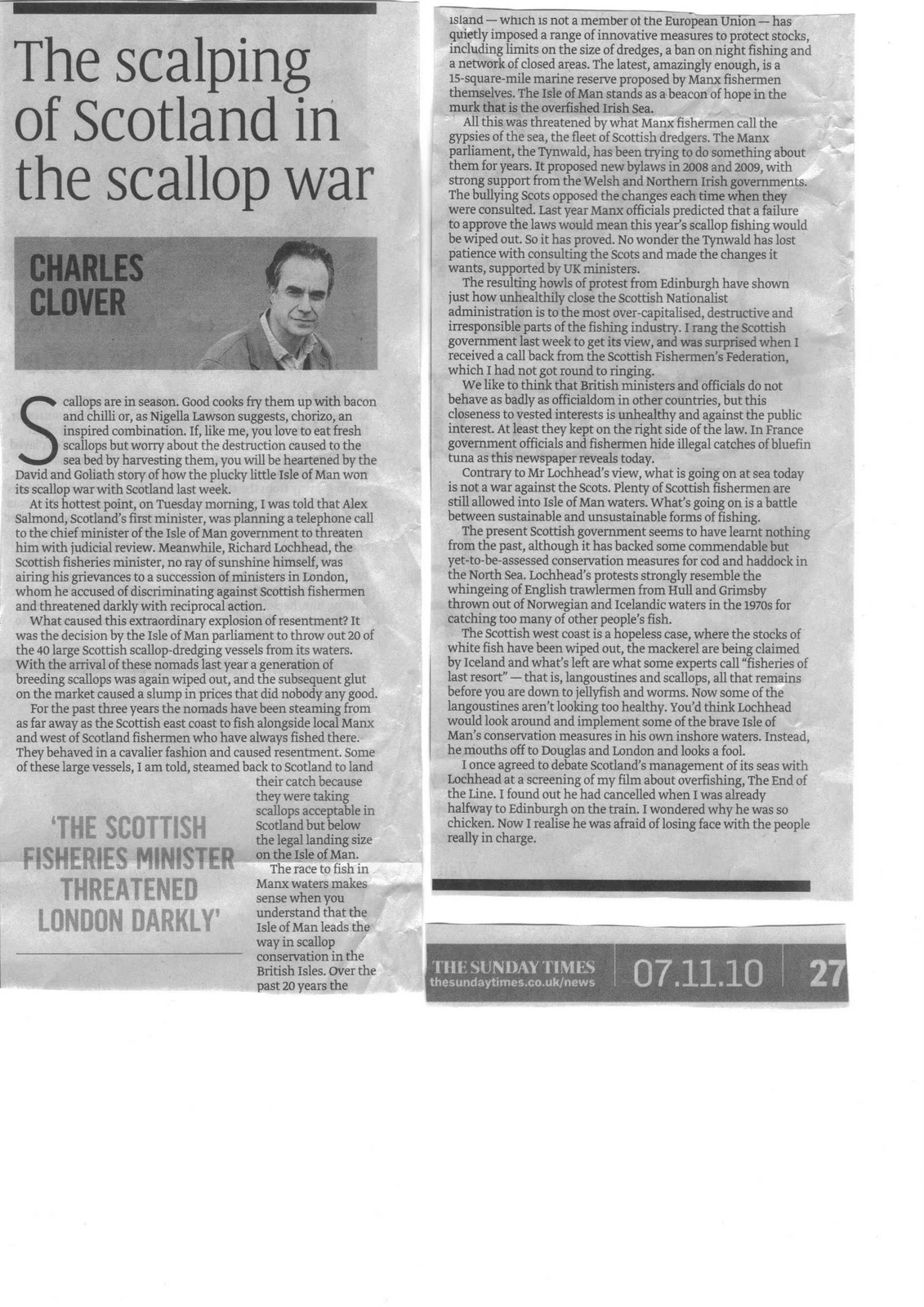
Charles Clover, The Scalping of Scotland in the Scallop War (Sunday Times, 7 Nov 2010)


News in on 12 November 2010:
Good news for porpoise!!!
It has just been decided that the tangle-net fishery off the West Coast of Scotland (ICES area) is to remain closed for the foreseeable future - the position will be reviewed in Jan 2013.

And a footnote from the other side:
"[… Are you] aware that many of the Isle of Man fishing boats move into our waters while the Irish Sea is closed? Obviously they must be mad fishing in our marine desert for the summer!
I should also point out that the closed areas are not necessarily permanent and may be re-opened when required. They were in fact agreed upon and suggested by the fishing fleet, unlike the ill-advised closure of our own Firth of Lorne.
I have had a successful year fishing in exactly the same places as 30 years ago, returning small scallops alive to catch next year and if that's not sustainable, I don't know what is! […]"
David Fraser, "proven sustainable scallop fisherman and dealer in facts"

Wednesday, 10 November 2010

An open email on Scallop and Tangle Net fishery management

David Ainsley sent this open letter on 10 Nov 2010 to Richard Lochhead, MSP, Jim Mather, MSP, and Kenneth Gibson, MSP:

Dear Cabinet Secretary,

I refer to the article in the Sunday Times 07.11.10 by Charles Clover [The Scalping of Scotland in the Scallop War]. In this article he expresses concern at "how unhealthily close the Scottish Nationalist administration is to the most over-capitalised, destructive and irresponsible parts of the fishing industry".
The Isle of Man is a model for how fisheries should be managed. It has a network of closed areas to allow scallop stocks to rebuild themselves after years of overfishing. The first closed area has been in place for 20 years and is produces 100 times the number of young scallops per unit area as compared with adjacent fished areas. The closed areas have been seen to be so successful that there are now six of them, designated with the support and involvement of the local fishing industry.
By contrast Scotland's fisheries are poorly managed, with nomadic fleets of dredgers moving into an area, causing a great deal of damage and then repeating the process elsewhere.
It is no surprise that the Isle of Man Administration seeks to protect its waters from some of these boats, as no doubt we would if the positions were reversed.
Voters are becoming aware of the problems caused by overfishing and media attention on the subject will continue to increase.
The loss of fish and shellfish is now so obvious, it is no longer credible to deny that a major problem exists.
Scottish Government represents the interests of all the people of Scotland, who have a public right to fish, and hence a right to call for their fish stocks to be managed sustainably. These interests are not the same as the vested interests of the fishing associations which disproportionately represent the damaging towed gear sector.
Last year at the CFP [EU Common Fisheries Policy] meetings in Brussels, there was a move by Scottish Government to call for the reopening of the tangle net fishery off the West Coast of Scotland. The fishery had been closed as one of the measures under the Cod Recovery Plan. The decision was for the fishery to remain closed and to be reviewed in 12 to 18 months. The inshore fishery targets Crawfish, a heavily overfished species. It also produces high levels of by-catch of porpoise and seals. It is probable that the majority of Scottish voters would not be in support of the reopening of a fishery which earns nobody a living and kills porpoise and seals.
I attach fuller information on the subject [David Ainsley's report: Scottish Porpoise under threat – see below].
Please keep me informed of when the subject will be considered again, and what the Scottish Government position will be.
It is not just fisheries, but the entire ecosystem including iconic wildlife and hence tourism, which flourish when areas are protected.

Yours faithfully,

[MPJ comments: diver, underwater nature explorer, author of Scottish Porpoise under threat (2010?) – for your own copy of the report, please leave a comment with your co-ordinates on this post and we'll get back to you. Needless to say, we will not publish your details!]
 
*****

PS by MPJ, your blogger:
See also 

Sunday, 24 October 2010

Using Sheep's Wool to Insulate Buildings

Sheep's wool is becoming a sought-after insulating material in the sustainable building trade. Here is an example from Guggisberg, a small village at an elevation of 1,115m/3,660ft in the hills about 45 minutes' drive south-west of Bern, the capital of Switzerland. Crofting life is tough in the Guggisberg area, which was a place of emigration until quite recently.

The article was written by Erwin Munter and originally appeared on 2 Nov. 2009 in the Berner Zeitung, one of the Swiss capital's two daily papers. It is available online in German, including a photo of father-and-son team, Gottfried and Ueli Mischler at work:
http://www.ee-news.ch/de/erneuerbare/article/19001/bauernhaus-mit-840-kilo-schafwolle-isoliert, accessed on 24 Oct 2010 (translation by Margret Powell-Joss | www.powelltrans.ch)

****

Berner Zeitung, 2 November 2009
GUGGISBERG

Croft Insulated Using 840 Kilos (1,848 lb) of Sheep's Wool

Gottfried and Ueli Mischler from Guggisberg have insulated their completely refurbished croft using processed sheep's wool. They are in line with the trend.

In the beginning, the Mischlers were a bit wary about using sheep's wool to insulate the completely refurbished living quarters of their 300-year-old farmstead. But not for long: "Sheep's wool insulation initially looked to be more expensive than the more traditional fibreglass or rockwool," says 21-year-old Ueli Mischler. But when using sheep's wool there is no need for a vapour barrier, a thin layer to prevent air and moisture exchange. And costs are offset by the ease of installing the sheets of wool, which moreover pose no risk to the skin. What's more, the insulating wool has been sourced locally. "Many a sheep farmer will be glad not to have to throw away the wool they harvest twice a year," says Ueli Mischler. Hintermholz, his 20 hectare (50 acre) croft lies at the foot of Guggershörnli, 1,291 metres above sea level.*)

A Local Product

The supplier of the insulating material called Woolin is Guggisberg's own Otto Brechbühl. For years he has been campaigning energetically for a meaningful use of new wool. "If you compare sheep's wool to other insulating materials, it will win hands down every time," the 73-year-old states, saying that the natural product can absorb and release large quantities of water vapour, and that it does not become infested with parasites. Mice cannot build nests in it, nor will they eat it. It does have to be treated against moths. New sheep's wool is a living, breathing material. Provided it is installed properly. Young farmer Ueli Mischler has done his homework, researching the material and inspecting several buildings insulated with sheep's wool. Otto Brechbühl hopes that more architects and builders will use sheep's wool. The Guggisberg manufacturer is adamantly opposed to this valuable natural product ending up in refuse bins.

840 Kilos of Wool

To ensure adequate insulation and sound-proofing of the completely refurbished farm house required sheep's wool mats weighing some 840 kilos, plus a few kilos of loose wool to insulate inaccessible nooks and crannies. The father-and-son team began refurbishment work in May and did a significant portion themselves, including masonry and joinery work. The project has progressed well, meaning that the Mischlers can move into their new home by the end of this month.
_________
Sheep's Wool – Active Despite the Crisis
Switzerland is home to some 450,000 sheep that each year produce 900 metric tons of wool, for which there has been no demand, meaning very low prices. About a third of the new wool is collected by refuse lorries. Marketing a product that is obtained twice yearly is barely worth the effort. One man who has been campaigning for years to make good use of new wool is 73-year-old Otto Brechbühl from Guggisberg. In 2008 he bought over 40 metric tons of shearings, which an Austrian company washed and carded for him. eml
_________

See also
Low Energy House - Sheeps Wool Insulation - Sustainable Insulation at http://www.lowenergyhouse.com/sheeps-wool.html
and
Centre for Alternative Technology at
http://info.cat.org.uk/questions/energy-conservation/can-i-use-my-own-sheeps-wool-insulation
and
The British Wool Marketing Board at
http://www.britishwool.org.uk/index_main.asp
all accessed on 24 Oct 2010.


*) Translator's note: The Guggershörnli is a steep-sided crag rising to 1,283 metres (4,210 ft). Walkers enjoy its easy accessibility – a 30-minute walk and short climb of sturdy wooden steps – to take in the unique views of the Alps, the Jura mountains and, on a clear day, the lakes of the Swiss Mittelland (see also http://www.myswitzerland.com/en/destinations/nature-travel-experiencing-nature/switzerland-parks/naturepark-activities/guggershoernli-360-panorama.html, accessed on 24 Oct 2010).